How much does a custom kitchen cost and how to plan it
On the Czech market, a custom kitchen made of laminated chipboard costs roughly CZK 15,000–30,000 per running metre, and CZK 25,000–45,000 with lacquered or veneered doors. A straight 4 m kitchen run therefore comes to about CZK 60,000–180,000 without appliances and without a stone worktop. The price is driven mainly by the door material, the number of drawers, the hardware and the worktop.
Below you will find indicative prices by finish, a model budget, dimensions for comfortable work and the process from measuring to installation.
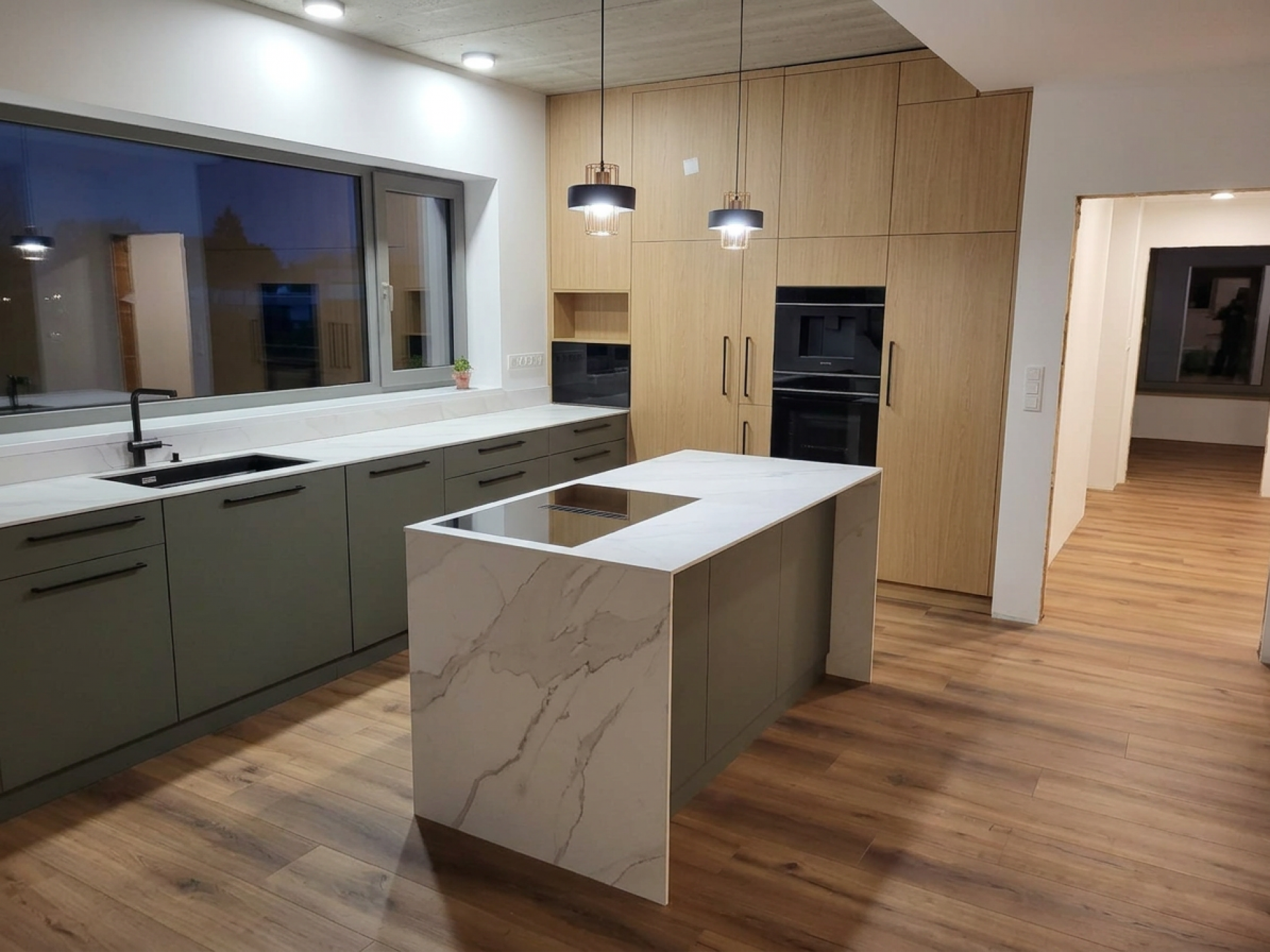
Kitchen with an island, completed by Vanprodukt
Indicative custom kitchen prices by finish
A running metre is measured along the length of the kitchen against the wall and includes both base and wall units. For an L- or U-shaped kitchen, the lengths of all sides are added up; an island is priced separately.
| Finish | Price per running metre | When it fits |
|---|---|---|
| Carcasses and doors of laminated chipboard, ABS edges | CZK 15,000–30,000 | flats, rentals, kitchens with simple flat doors |
| Laminated chipboard carcasses, lacquered MDF or veneered doors | CZK 25,000–45,000 | a specific RAL or NCS colour, matt lacquer, the look of real wood |
| Solid wood, irregular shapes, premium hardware | CZK 40,000–65,000 | rounded elements, kitchens for historic houses, solid wood doors |
Prices exclude appliances, sink, tap and a stone worktop. The ranges are based on published price lists of Czech joinery companies for 2025–2026. The exact price is only set by a design with specific dimensions and fittings.
Model budget: a straight 4 m kitchen
| Item | Indicative price |
|---|---|
| Laminated chipboard units (base and wall, 4 running metres) | CZK 60,000–120,000 |
| Stone worktop instead of a laminate one | CZK 0–40,000 extra |
| Sink, tap, handles and small hardware | CZK 8,000–20,000 |
| Built-in appliances | depending on choice, a separate item |
A kitchen of the same length with lacquered doors, full-extension drawers instead of shelves and a stone worktop can easily double the price. The difference is not the length but the fittings.
Want to know how much your kitchen will cost? Send us a floor plan with dimensions, photos of the room and a list of appliances, and we will prepare a design and an indicative price. Write to us.
What raises the price of a kitchen and where to save
The price goes up mainly with moving parts and extra work:
- Drawers instead of shelves: a base unit with three full-extension soft-close drawers costs more than a unit of the same width with a door and a shelf.
- Corner solutions: swing-out or pull-out hardware for a corner unit is one of the more expensive items of the whole kitchen.
- Handleless design: a milled channel in the carcass or push-to-open requires more work and special hardware.
- Lacquered doors: lacquer is applied in several coats with sanding in between. High gloss is more demanding than matt.
- Irregular shapes: rounded corner shelves, bevels under a sloping ceiling or rounded islands are milled on CNC from separate production data.
You can save where it does not show. Carcasses can be laminated chipboard even in a kitchen with lacquered doors. Units in the standard widths of 40, 45, 50, 60, 80 and 90 cm are produced more efficiently than custom sizes, and a custom size can be kept just for the filler next to the wall. Wall units up to the ceiling cost less than a separate pantry.
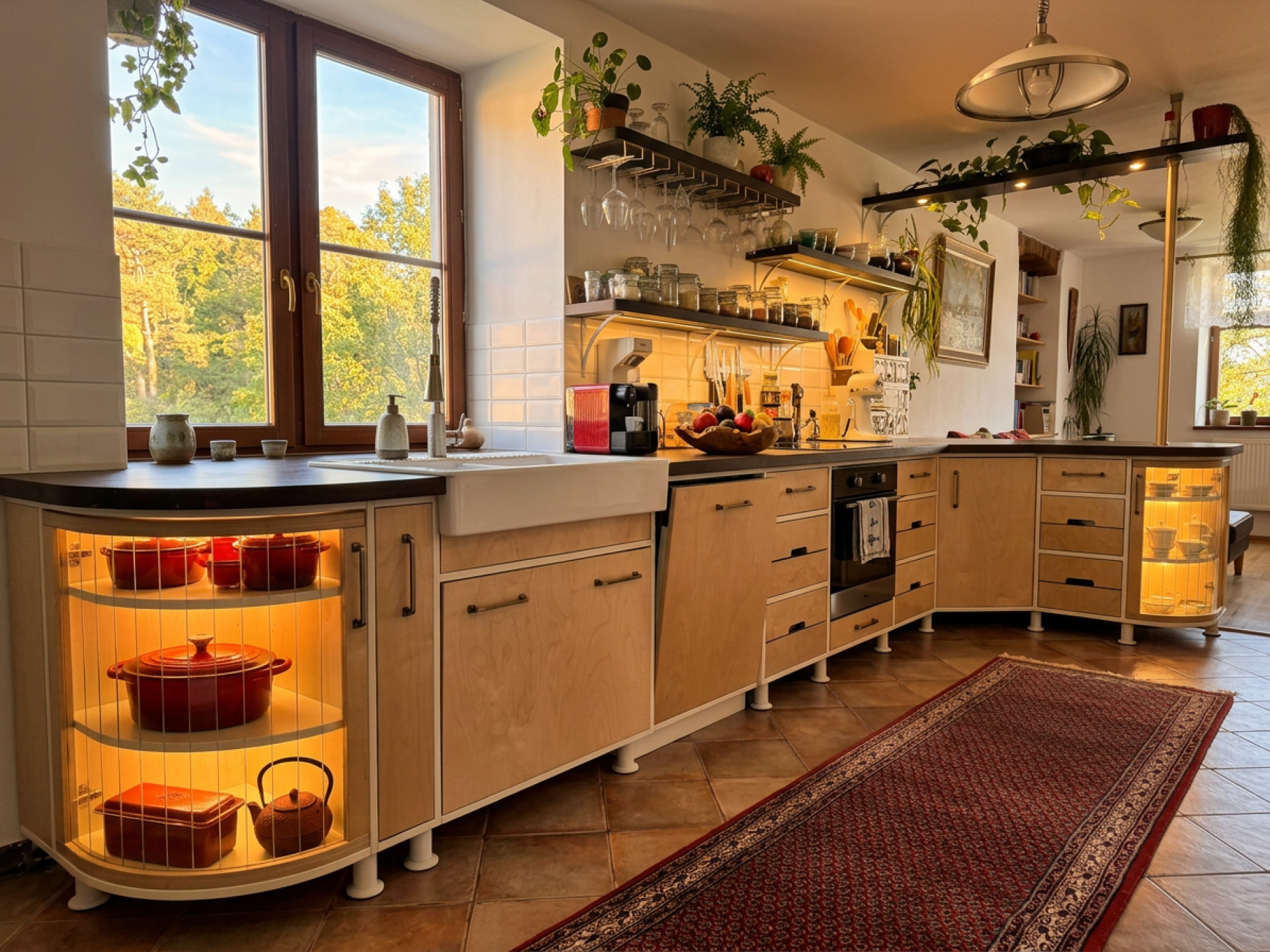
Solid wood kitchen with rounded shelves, completed by Vanprodukt
Dimensions that decide how comfortable the kitchen is
Most problems of finished kitchens come not from the material but from the dimensions. These values are common recommendations for kitchen design:
| Parameter | Common value | Note |
|---|---|---|
| Worktop height | 85–95 cm (most often 90 cm) | about 10–15 cm below the elbow of the person who cooks most |
| Worktop depth | 60 cm | base units are about 56 cm deep, the rest is overhang and space for services |
| Wall unit depth | 30–35 cm | deeper units get in the way of your head while working |
| Gap between worktop and wall units | 50–60 cm | less restricts work, more makes the upper shelves harder to reach |
| Cooker hood above the hob | according to the manufacturer's instructions, usually 65 cm above an electric and 75 cm above a gas hob | check the installation manual of the specific model |
| Passage between the kitchen run and the island | 100–120 cm | less than 100 cm is not enough for an open dishwasher and a second person passing |
| Work surface between sink and hob | at least 60–90 cm | the main food preparation area |
| Distances fridge – sink – hob | 1.2–2.7 m each | the so-called work triangle without unnecessary walking |
How an order goes from measuring to installation
- Brief. A floor plan with dimensions, ceiling height, photos, positions of water, waste, electricity and extraction. A list of appliances including specific models, because built-in appliances have prescribed niche dimensions.
- Design and quotation. 3D visualisation, choice of decors and materials, budget. Changes are easiest at this stage; once production starts they mean new parts.
- On-site measuring. The exact dimensions are taken only after the plaster and floor are finished. Tiling behind the kitchen is done after installation so that it meets the worktop.
- Technical preparation and production. The design is converted into production data, and the parts are cut, CNC machined and edge banded.
- Installation. Setting and levelling the units, fitting the worktop, doors and appliances and adjusting the hardware.
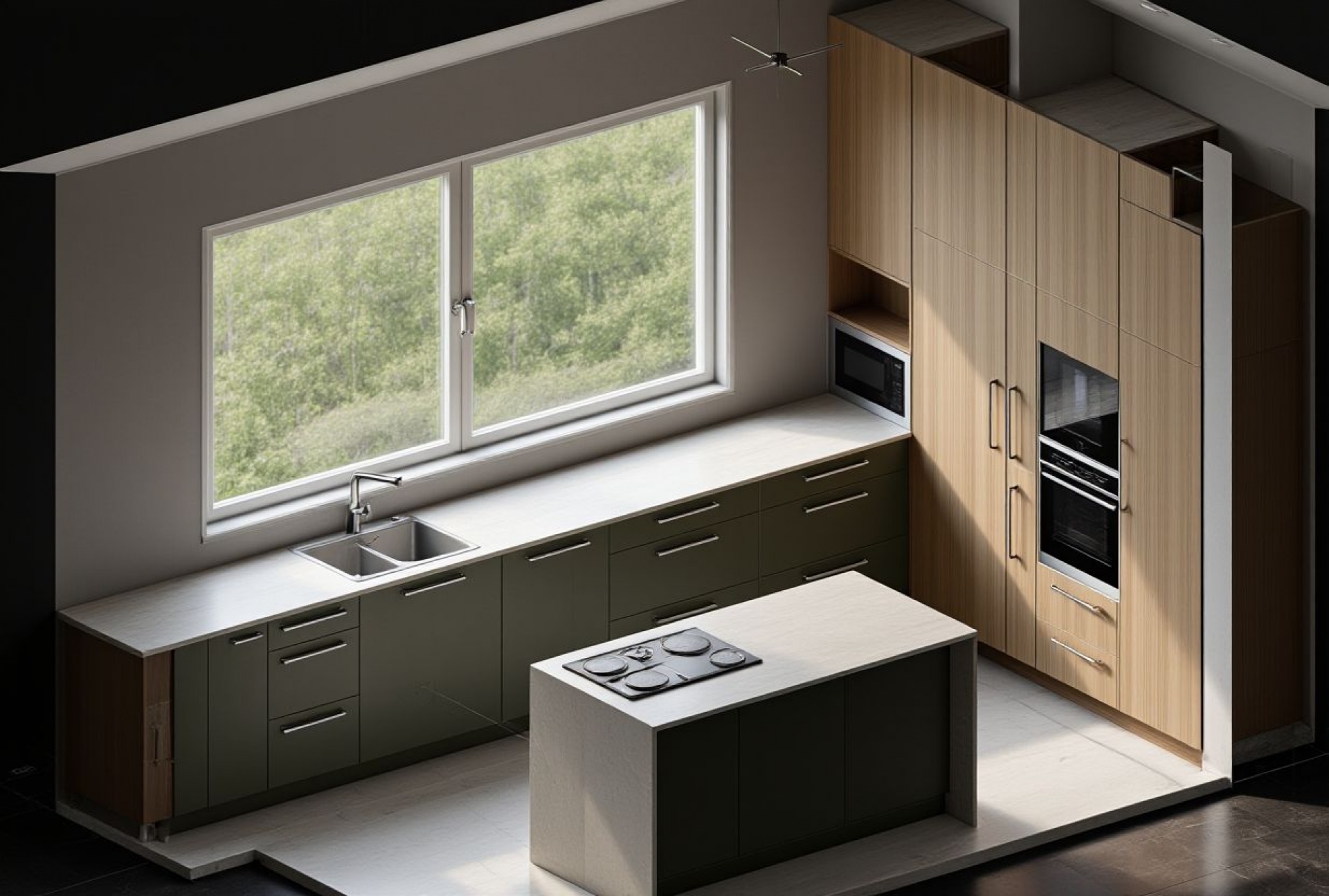
3D visualisation of a kitchen before production
When a custom kitchen does not pay off and what to watch out for
- A straight run in a rectangular room. If a 3 m run fits between two straight walls in standard modules, a catalogue kitchen is usually cheaper. Custom pays off when you want to use the height up to the ceiling, a recess, a sloping ceiling, a column or a specific material.
- Quotations without a breakdown. Compare like with like: carcass thickness (usually 18 mm), the edge type on visible surfaces, the brand and type of runners and hinges, the worktop material and what is included (transport, installation, fitting the appliances).
- Appliances chosen after production. Dishwashers come in widths of 45 or 60 cm, and a built-in fridge needs a niche to suit the specific model. Choose the appliances before the final design.
- Withdrawal from the contract. A kitchen made to your specification cannot be returned within 14 days like goods from an online shop (Section 1837(d) of the Czech Civil Code). Review the design thoroughly before ordering.
Custom kitchens from Vanprodukt
Vanprodukt is a family company that has been making furniture since 1992 in its own premises in Pavlov near Pelhřimov. The kitchen design is converted into CNC data in IMOS and AlphaCAM, parts are machined on a 5-axis CNC centre, edges are banded on an IMA Novimat line and lacquered doors are made on our own lacquering line. We work with board materials, solid wood and metal, so one kitchen can combine, for example, lacquered doors, a solid wood worktop and metal shelves.
Our projects include kitchens with an island as well as a solid wood kitchen with rounded corner shelves. Finishes and materials are summarised on the custom kitchens page. What else affects the price of custom furniture is described in the article what affects the price of custom furniture.
Planning a new kitchen? Send us the room dimensions, photos and your idea of the fittings. We will prepare a design and an indicative price. Contact us.
Frequently asked questions about custom kitchens
Is a stone worktop worth it?
A laminate worktop is the cheapest but sensitive to water at the joints and around the sink. Compact HPL withstands water and is thin, while stone or composite is the most resistant to heat and scratches but can add up to CZK 40,000 on a 4 m kitchen. The right choice depends on how much cooking is done in the kitchen.
Is a handleless kitchen more expensive?
Yes. A milled channel in the carcass or push-to-open means more work and more expensive hardware than classic handles. Push-to-open drawers also use electric or mechanical opening hardware.
Can a custom kitchen be made of solid wood?
Yes. Solid wood needs a quality oil or lacquer finish and reacts to moisture, so it is important to protect the edges around the sink and dishwasher. A solid wood worktop or doors are often combined with carcasses made of board material.
Do the appliances have to be chosen in advance?
Yes, at the latest before the final design. A built-in oven, microwave, fridge and dishwasher all have prescribed installation dimensions, and the carcasses and doors are made to suit them.
Can I withdraw from a custom kitchen order within 14 days?
No. Under Czech law, the 14-day right of withdrawal applies only to contracts concluded at a distance or off business premises, and even there it is excluded for goods customised to the buyer's wishes (Section 1837(d) of the Civil Code).